


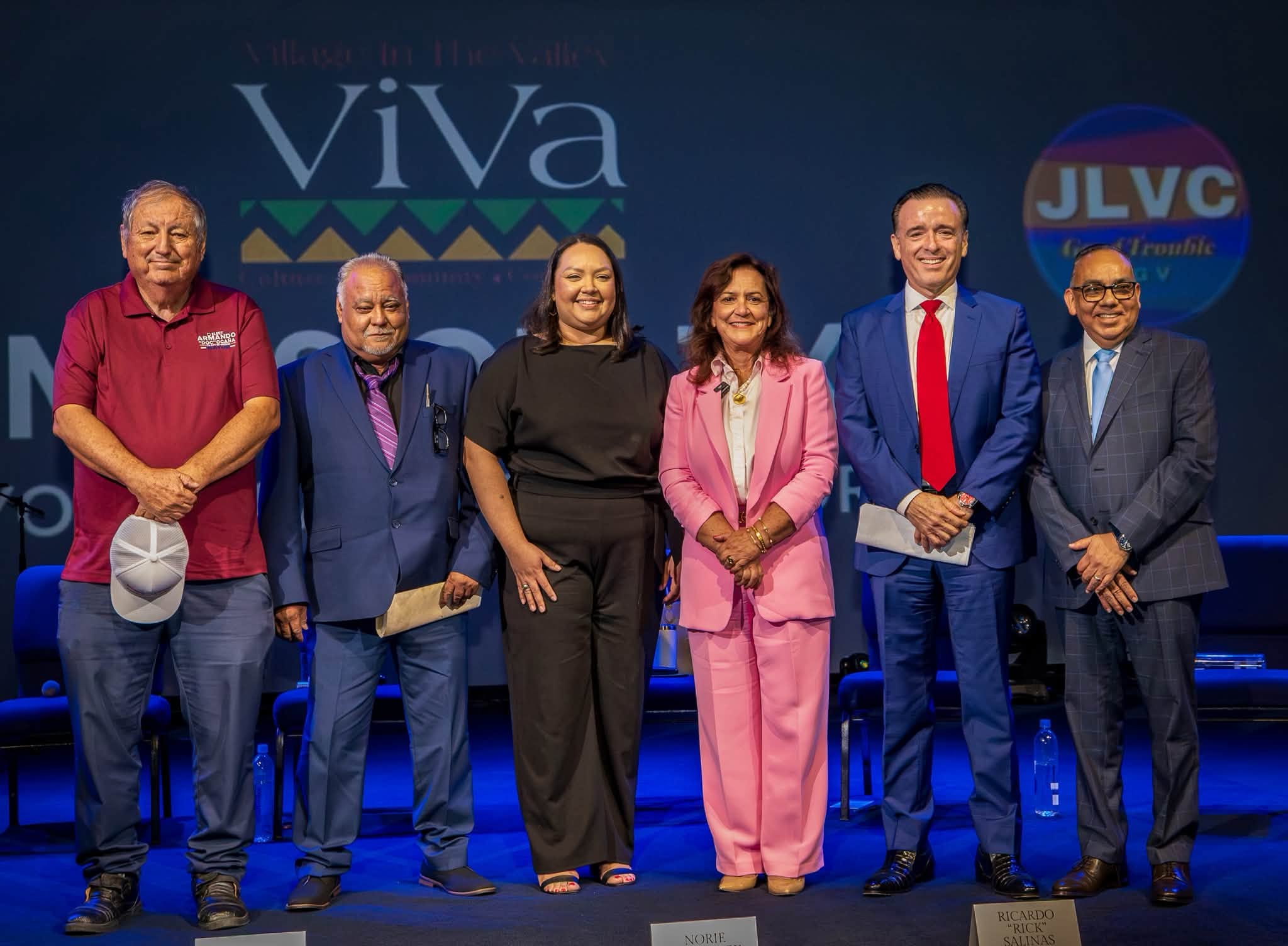
16 Oct Six Candidates, One Stage: Mission Mayoral Hopefuls Debate Districts, Budget and Drainage
All six candidates for Mission mayor shared a stage Wednesday, Oct. 14, at Freedom Life Church, where they disagreed on council election procedures, the health of the city budget and tax breaks, per local news reports. They also addressed how the mayor should work with the city manager and what to do about drainage.
Village in the Valley (ViVa) hosted the forum with Leadership Mission and the John Lewis Voter Coalition of Hidalgo County. Jeff Patterson, chairman of the Greater Harlingen Area Chamber of Commerce, moderated, and questions came from three weeks of listening sessions with residents.
On the ballot are Mayor Norie Gonzalez Garza, Mayor Pro Tem Ruben Plata, former Mayor Armando “Doc” O’Caña Sr., attorney Rick Salinas, businesswoman Natalie “Nati” Garza and business owner Juan Gines Crispin. O’Caña was mayor for four years starting in 2018, and Salinas is the son of one of his predecessors, Norberto “Beto” Salinas.
The first question asked whether Mission should keep electing its council citywide or have residents in each part of town choose their own member. O’Caña wants to split the city into four districts and grow the council to seven members, and Crispin backed adding seats for more representation. Gonzalez Garza said single-member districts suit bigger cities, not Mission, but she is open to adding seats while keeping them citywide. Salinas wants a hybrid system with a minimum of two districts, one for each of the west and south sides. Plata doesn’t favor districts but supports the four quadrants the city once had. Garza is open to districts if residents want them, and pitched regular town halls and an upgraded Mission 311 line that follows up on requests.
How a mayor should work with the city manager brought the sharpest friction. Candidates alluded to the city’s former manager without naming him. Salinas said Mission had a great manager and let him go, pointing to a wider problem of keeping good ones. He said a mayor should set goals and let the manager carry them out, free of politics and favoritism. Plata and Gonzalez Garza defended the decision. Gonzalez Garza said the manager was open to returning $1 million in federal grant money that would have paid for nine police officers, which she said made no sense. Crispin wants a team approach. Garza would leave daily operations to the manager but keep oversight. O’Caña would turn complaints into measurable targets with an evaluation model he built as mayor.
All six backed more transparency on city money but disagreed on the health of the budget. Salinas said Mission faces the worst financial crisis in its history and wants all meetings to be televised plus monthly budget reports. Gonzalez Garza called that false, saying the lowest point was 1984, when then-Mayor Pat Townsend borrowed from a bank to cover operating costs. She called the city’s position good, if not the best, and cited the economic development corporation and tourist board as funding sources. Salinas replied that finances are at their lowest point, noting the city lacked a triple-B bond rating in Townsend’s era and that re-electing the same people would bring the same rating. Plata said the budget would be his first job, with a plan to bring the city into compliance and raise employee pay. O’Caña would ask for quarterly revenue and spending reviews. Garza said the recently approved audit of the economic development corporation should become routine, and Crispin would make financial information easy to understand.
Incentives drew a split too. O’Caña opposes tax abatements and wants manufacturing and development of the south side through Tax Increment Reinvestment Zone 2. Plata said big chains and corporations don’t all need breaks and would steer help toward small businesses. Gonzalez Garza supports incentives with standard requirements. Garza and Crispin back incentives that deliver proven results, and Garza wants contracts that let the city recover money from companies that fall short. Salinas wants businesses that send plenty of sales tax back to the city, not ones that drain services.
Candidates mostly agreed on chasing grants for drainage and infrastructure. Garza wants a capital plan with real numbers on costs, funding, timing and accountability so residents can follow projects, and said the city shouldn’t build plans on money it doesn’t have. O’Caña said heavy flooding early in his 2018 term led him to spend about $1 million on a drainage study that produced 21 projects. About 17 were done when he left office, and he hopes to finish the rest. Gonzalez Garza and Plata cited recent projects completed in their terms. Crispin called drainage a major problem and said he’d bring in development experts to find fixes. Salinas blamed years of put-off upkeep and proposed separating the sanitation, water and sewer funds so each can grow on its own.
Tension surfaced at times. When Salinas pointed at the incumbents during the incentives discussion, audience members called out against attacks, and the moderator reminded candidates to keep it civil, drawing applause. With six candidates, a runoff is possible.
Early voting opens Monday, Oct. 19, and closes Oct. 30, ahead of Election Day on Tuesday, Nov. 3.
No Comments