


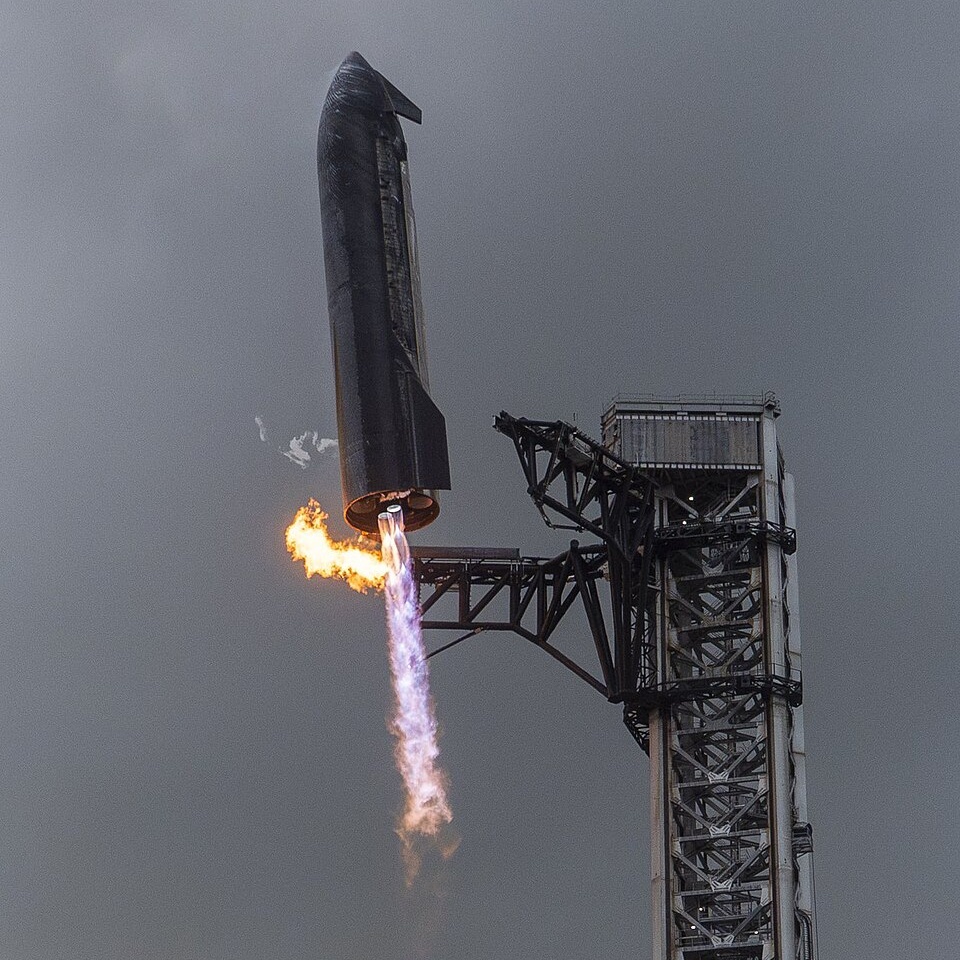
16 Nov SpaceX Catches Starship at Boca Chica on First Attempt
SpaceX caught a Starship upper stage with its launch tower on Saturday, a first, returning the vehicle to the pad at Boca Chica that it left the day before, per the Brownsville Herald.
The ship, designated S34, was grabbed by the tower’s mechanical arms while still firing its engines on approach to the pad. A SpaceX spokesman, Dan Huot, announced the catch at 3:24 p.m., 22 hours and 32 minutes after liftoff. “Mechazilla has grabbed the Starship,” Huot said. “We have been waiting to hear that for a long time.” The BBC reported the return ran several minutes later than planned.
Flight 15 launched from Starbase late Friday afternoon, Nov. 13. The planned catch of the Super Heavy booster, B22, did not go ahead. About six minutes after liftoff, the booster’s onboard guidance computer determined it was not positioned correctly for a catch and triggered an automated abort, Huot said. The booster then headed to its offshore splashdown zone. The BBC reported that the booster erupted in flames shortly before reaching the water.
The ship continued into orbit, where it deployed 26 Version 3 Starlink satellites, then circled in low-Earth orbit for over 22 hours. SpaceX said beforehand that it would attempt a return to the launch site only if its flight control team confirmed that the systems needed for reentry, the closing engine burn and the tower approach were healthy. SpaceX said a successful recovery “will mark the first full recovery of an orbital launch system and a breakthrough moment in making Starship a reliable, rapidly reusable rocket.”
SpaceX had pulled off a tower catch three times with the larger Super Heavy booster but never with a ship. Recovering and reusing hardware is central to the company’s aim of sharply lowering the cost of sending cargo, and eventually people, to space on Starship.
Starship also figures in NASA’s lunar plans. The agency awarded SpaceX a contract valued at $4.4 billion, which grew from an initial $2.9 billion award in 2021, to build Starship into a crewed lunar lander that would put astronauts back on the moon, which has not happened since 1972. Delays in the vehicle’s development led NASA to rework its Artemis program and contract with Blue Origin, founded by Jeff Bezos, as a second lander provider.
In February, NASA said Artemis III, once meant to be the first landing, would instead be an Earth-orbit test of systems and operations, setting up a landing on Artemis IV in 2028. One goal of that mission is “rendezvous and docking with one or both commercial landers from SpaceX and Blue Origin,” NASA said.
No Comments