


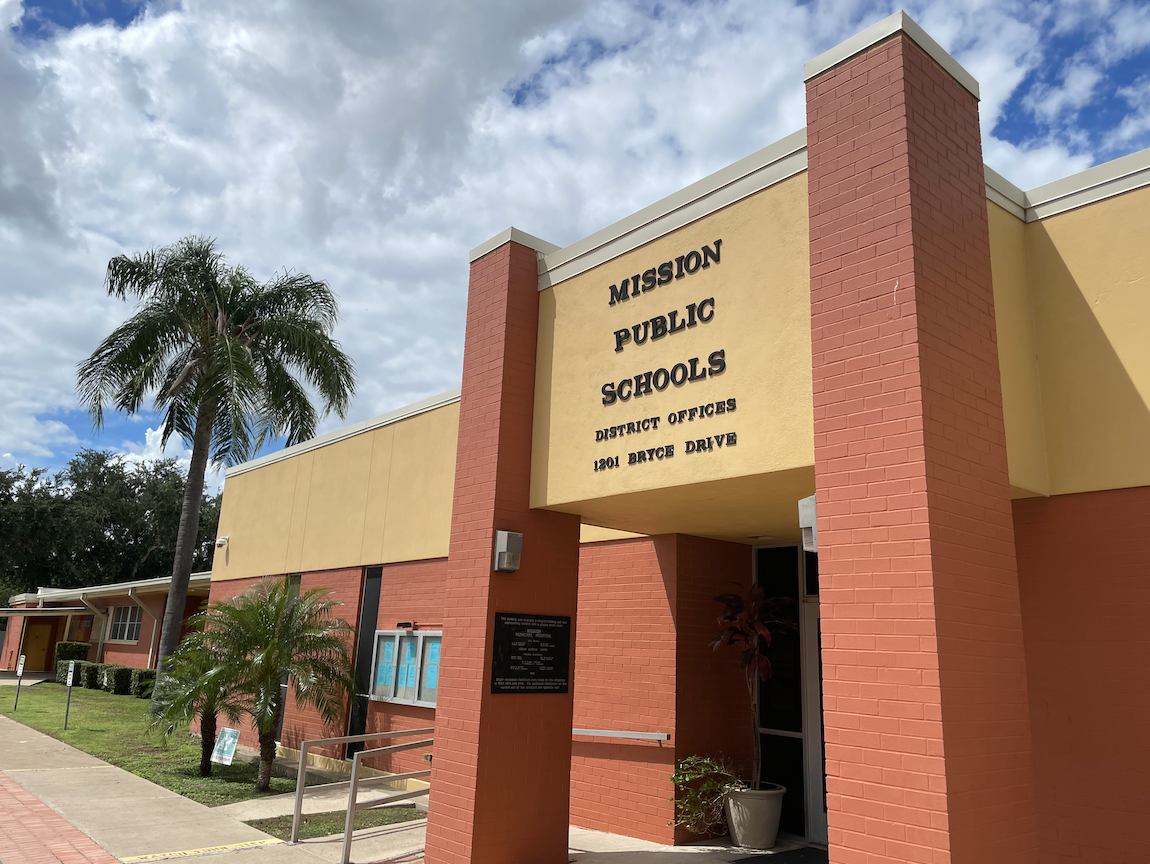
27 Oct Mission CISD to review programs and staffing as enrollment declines
The Mission school board voted Oct. 21 on a resolution directing Superintendent Cris King to review the district’s programs, services, staffing and spending as enrollment falls. King is also to develop options for bringing those areas in line with current and projected enrollment and educational needs.
The resolution points to falling enrollment, spending that exceeds projected revenue and a shrinking fund balance. Enrollment fell from 14,503 students in 2022-23 to 12,868 as of Oct. 14, a loss of 1,635 students, or about 11.3%. District projections show it declining another 8.3%, to roughly 11,796, by 2031-32.
The 2026-27 general fund budget lists revenues of $187.8 million and expenditures of $200.2 million, with payroll making up about 80% of that spending. The unassigned general fund balance went from $81.35 million on June 30, 2023, to $60.39 million on June 30, 2025. Staffing has shrunk by less than enrollment, from about 2,264 full-time-equivalent employees in 2022-23 to 2,118 this year. The district has 14 students per teacher, compared with 15 statewide.
The review is to cover enrollment trends, program demand, staffing patterns, service requirements and operating costs. For each option, administrators must assess the effects on instruction and operations, whether students keep access to services they require, the savings expected each year, one-time transition costs and legal requirements. The resolution does not adopt any program change or authorize any employment action. Anything requiring board approval would come back separately.
King is to give the board a preliminary report in November and refined options in December. Recommendations are due in January 2027, along with a plan for putting them in place for the 2027-28 school year and any transition period.
Board President Natividad “Nati” Sosa said she backed the resolution because it formalizes the plan and gives the work a framework and a timeline, according to The Monitor. The effort has moved past conversation, she said, and the district is acknowledging the problem and getting ahead of it. She attributed the decline to larger graduating classes and lower birth rates and said more decline is expected. Spending as though the district had more students than it has, or is projected to have, keeps money out of classrooms, Sosa said, likening it to living beyond one’s means.
A proposed 2026-27 district improvement plan that was also on the board’s agenda lists low birth rates, area charter schools, out-of-district enrollment, high student mobility and housing among the reasons for the decline.
Some of the data collection is already underway, Sosa said, and figures on the central office and high schools are available to any trustee who requests them. An earlier workshop covered only elementary schools. The district will also examine whether its programs remain attractive to families and cost effective, she said.
Changes in enrollment and program participation from 2022-23 to this school year, as listed in the resolution:
- Career and technical education: 6,636 to 4,642 students, down about 30%
- Bilingual program: 2,263 to 1,804, down about 20%
- English as a second language: 3,274 to 2,099, down about 36%
- Emergent bilingual: 5,620 to 3,918, down about 30%
- Gifted and talented: 1,691 to 1,518, down about 10%
- Section 504 services: 1,144 to 851, down about 26%
- Economically disadvantaged: 12,569 to 10,083, down about 20%
- At risk: 10,903 to 9,171, down about 16%
- Special education services: 1,499 to 2,209, up about 47%
- Dyslexia: 670 to 1,037, up about 55%
- Migrant students: 122 to 160, up about 31%
No Comments